
Steven McKay
Steven has worked in stone all his life, from gable ends in the Highlands to a hillside in the Alentejo. He has enjoyed the second half most.
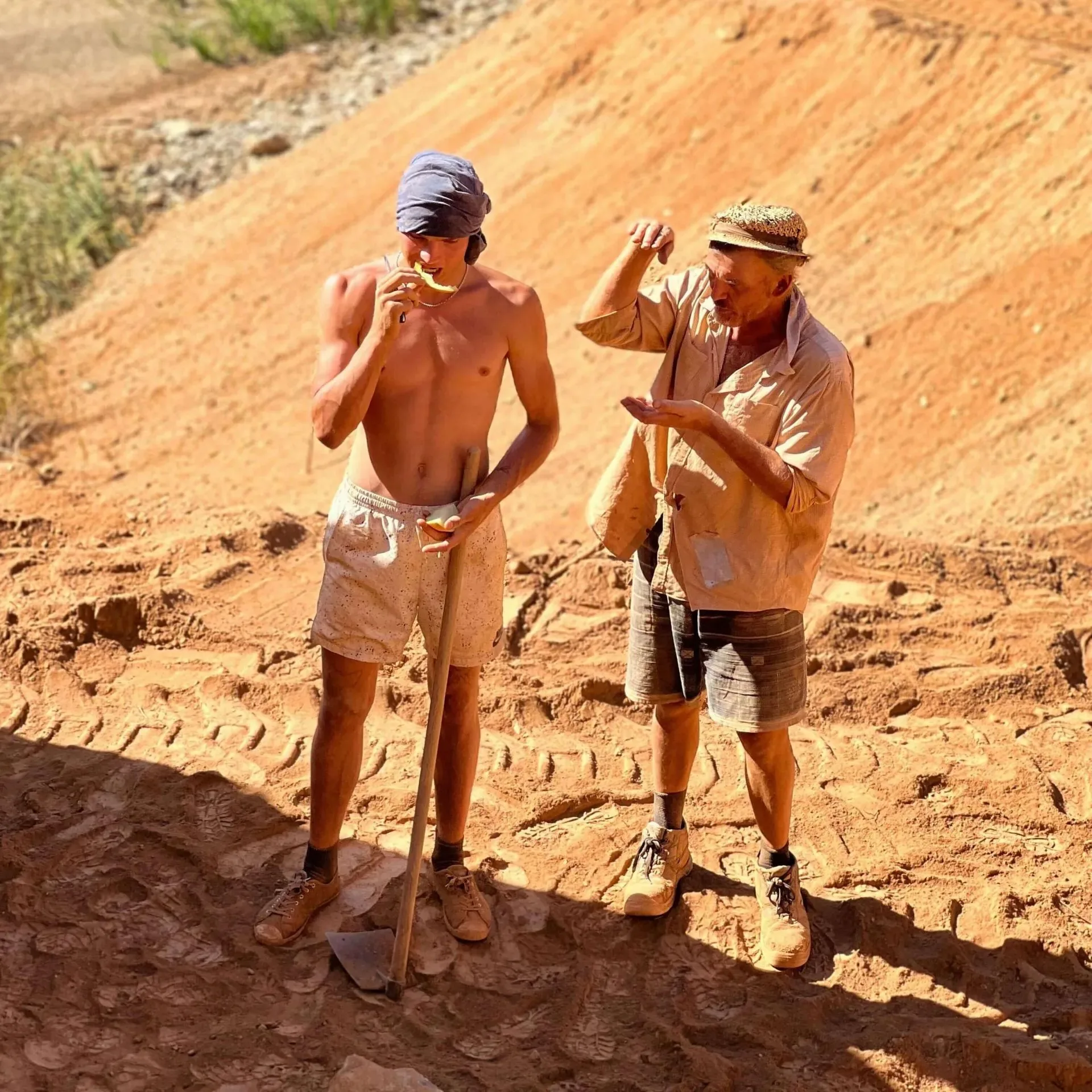
Steven learned the trade in the north of Scotland, mostly on repairs: chimney heads that had lost their mortar, gable ends that had started to lean, field walls the winter had pulled down. The stone was granite, whinstone and sandstone, and the climate shows up any mistake within about eighteen months.
What he learned in Scotland
When you take down a wall that has stood for two hundred years, you can see what its builder was thinking, including the corners they cut. You learn to read a wall the way other people read handwriting. You also find that almost every failure comes back to the same short list: loose or missing hearting (the small stones packed inside the wall), joints that run (vertical gaps lined up over each other), no throughstones (long stones that tie both faces together), and water that had nowhere to go.
And you learn to be patient with the weather. A wall built in Sutherland in October has six months of freeze and thaw to get through before anyone knows whether it was any good.
Why the Alentejo
The stone here is schist and quartzite: flat, layered, generous with its beds, and quite different to work than granite. The landscape is full of walls and terraces built the same way from the same stone. Some have held up olive groves for several centuries. Many are falling down because nobody is left who knows how to repair them.
He moved out to a hillside in the Alentejo and started building: a gateway, a track wall, terraces, steps and a seat under an olive tree. People kept asking to come and help.
Over the years he has also built houses for his family and children. The land in the Alentejo, Nature's Portal, is his latest project, and it is where the walling weeks of Stone Sport take place.
How he teaches
Groups are small, and apart from the first morning there are no lectures. Most of the teaching happens with Steven next to you, a stone in his hand, asking why you chose that one. He shows you a technique twice and then you try it yourself. That can feel uncomfortable for about a day, and after that it is how you learn.
Nobody expects you to be good at this after one week. We hope you leave with a working eye: you look at a heap of stone and can see which one goes in next. That stays with you long after the week.
Come and build with Steven
A week in a group of eight, with a wall built by the end of it.